



The old baby farmer, the wretched Miss Dyer
At the Old Bailey her wages is paid.
In times long ago, we'd 'a' made a big fy-er
And roasted so nicely that wicked old jade.
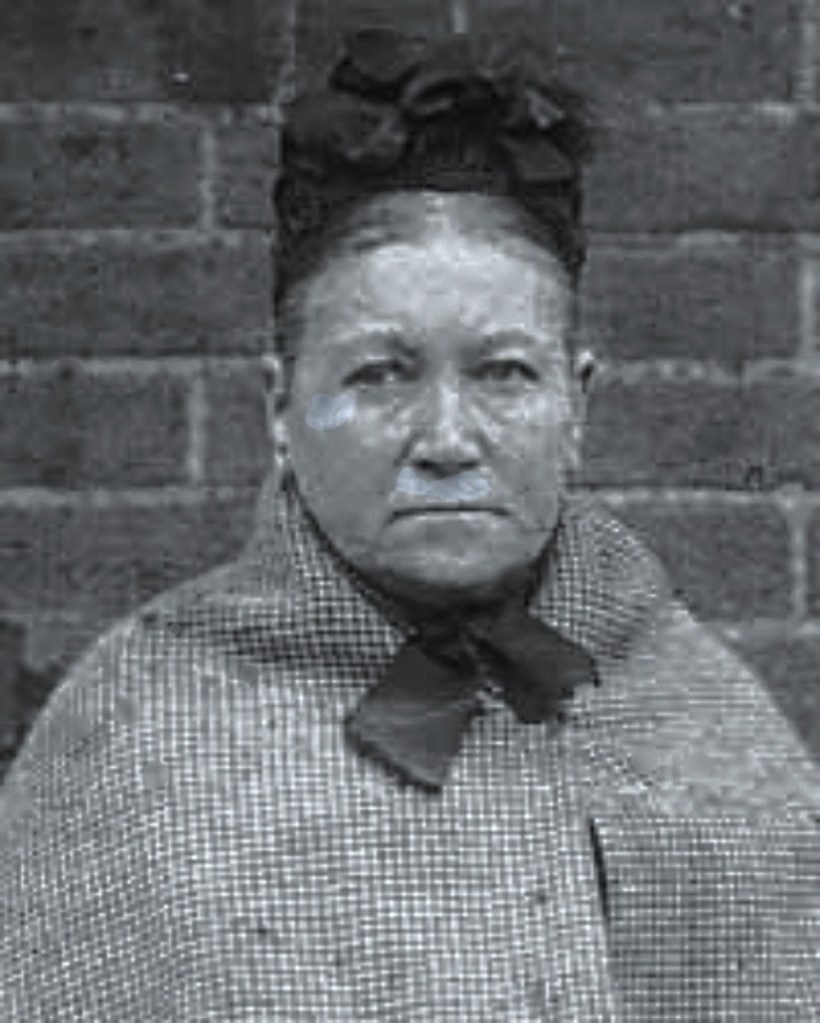
Perhaps one of the most recognised, and despised, faces to be found in the depths of England’s criminal history, is one Amelia Dyer; the infamous baby farmer of Victorian London. Her life and crimes shed light on the grim underbelly of a society so extreme in it’s unwritten rules of acceptable attitudes and behaviours, that it allowed heinous acts such as hers to not only go on without attention but also to thrive. Dubbed ‘The Ogress of Reading’, Amelia became the face of far more widespread horrors, as she was certainly not the only one to be taking advantage of the vulnerable and the outcasts of Victorian society; ‘fallen women’ and children born into poverty or out of wedlock.
She was born Amelia Elizabeth Hobley, on June 10th 1836, and was the youngest of five children. Her family lived in the small village of Pyle Marsh, just outside of Bristol (UK), and it is said that the children were all provided a ‘stable’ upbringing. In fact, Amelia had the great opportunity of learning to read at a time when only about 40% of girls and women were literate in England. She developed a great love for books and poetry, indulging in them every spare moment she had. Sadly, time spent with her books would soon become near impossible, as Amelia’s Mother contracted Typhus (believed to be Epidemic Typhus) and the young girl was tasked with caring for her.
During the latter stages of a typhus infection the patient can suffer from hallucinations and an ‘altered mental state’. There are some that believe that it was during the care of her Mother that Amelia learnt to recognise, which allowed her to later imitate, signs of certain mental health conditions. After her Mother’s death in 1848, Amelia went to live with an Aunt in Bristol, and found work as an apprentice corset maker.
In 1861, following an estrangement from one of her brothers, Amelia moved into a lodging house in Bristol. Here she would meet George Thomas, a man 35 years her senior, and they would marry soon after. Once they were married, Amelia began training as a nurse and this is where she met Ellen Dane, a midwife who would teach the trainee nurse a far easier way of making money – baby farming.
Sidenote – Soon after their meeting Ellen would be forced to flee to the US to ‘escape the attention of the authorities’.
Baby farming became most prevalent in late-Victorian Britain and would involve the ‘baby farmer’ taking payment (sometimes a lump sum, sometimes an agreed upon monthly amount) in exchange for custody of a child. The money handed over was supposed to be used to provide for the child until the parent/s could bring them home or an adoptive family could be found. It would be single Mothers who turned to the baby farmers most often, trying to escape the social stigma of having a child out of wedlock despite many of them falling pregnant through sexual assault. However, there would also be young couples who simply needed time to get married and find a home, and already married couples who could not afford to raise another child (no contraception remember, and the husband was within his right to have ‘relations’ with his wife whenever he wished).
Whilst there were some baby farmers who operated with good intentions, many of them understood that it was more profitable if they did not have to take care of a child for too long, enabling them to keep more of the money paid by the parent/s. This was especially true in the case of ‘lump-sum adoptions’, as one-off payments would often not be enough to cover the care of a child for more than three or four weeks. This coupled with the lack of oversight and regulation within fostering and adoption practices in Britain at the time meant that the baby farming industry was rife with abuse and neglect.
Following Ellen Dane’s departure, Amelia fell pregnant with her and George’s only child, a daughter named Ellen Thomas, and she was forced to leave her nursing career. Then in 1869 the elderly George Thomas passed away and Amelia needed to start earning an income quickly. Remembering the advice of her departed mentor she began to place adverts offering to adopt and/or find homes for children whose parents could not take care of them. We do not know if her initial foray into baby farming might have started with a semblance of care, but it quickly devolved into a nightmarish enterprise.
She soon realised that the most profitable way to manage her enterprise was to pocket the total payment from her desperate clients, and in order to do this she needed to get rid of the babies in her care as quickly as possible. During the 1870’s Amelia honed her craft, taking in dozens of children, collecting her fees and then disposing of them, usually through starvation or drugging which were favoured methods by many unscrupulous baby farmers at the time.
In 1872 Amelia remarried, William Dyer was a brewer’s labourer from Bristol and they would go on to have two children together; Mary Ann, aka Polly, and William Samuel. At some point the couple separated, this is believed to have been Amelia’s decision, however, according to her children, she was not an easy person to live with. The notorious baby farmer had a burgeoning addiction to alcohol and laudanum, the very drug she had been using on her charges, and was said to suffer from acute paranoia and have a nasty temper. One of her daughters stated that Amelia accused her of trying to murder her on several occasions and threatened to kill her first. Their home was also constantly busy, with a never-ending stream of heavily pregnant women hiding away for the last few weeks before childbirth and of newly ‘adopted’ children.
Several years would pass before Amelia was eventually caught in 1879. A Doctor who had grown suspicious of the number of child deaths he had been called to certify at the Dyer’s residence informed the authorities and Amelia was arrested. To the surprise, and outrage, of many in her hometown, she escaped a murder charge and was instead convicted of neglect. Amelia served six months hard labour which allegedly further affected her drink and drug addled mind.
Once released Amelia returned to baby farming, but this time she had learnt a valuable lesson. In order to get away with her crimes she would need to dispose of the bodies herself, she could not risk involving Doctors anymore. Despite changing her modus operandi when it came to hiding the evidence, the baby farmer would still eventually attract the attention of the authorities. To evade capture she and her family would often relocate and they spent a great deal of time travelling the country under several aliases, each time setting up a new ‘business’ before being forced to move on again. However, Amelia would be caught out on at least two occasions, each time coinciding with a mental health crises and/or suicide attempt. Some believe this was a clever ploy to escape a murder charge and the punishment of execution that would follow it, others that Amelia was genuinely unwell and, unable to access any kind of effective treatment, would snap under the pressure of an investigation.
Amelia’s last committal was at the Somerset and Bath Lunatic Asylum which, according to her family, was such a ‘disagreeable’ experience that she would refuse to enter another asylum. She was discharged from the hospital in 1893 and two years later, in 1895, would move to Caversham in Berkshire, along with Mary Ann (daughter), Arthur Palmer (son-in-law) and Jane ‘Granny’ Smith, whom Amelia had met in a workhouse. Soon after they would move again, this time to Reading, Berkshire, and Jane would be convinced by Amelia to pose as her Mother whilst meeting prospective clients in the hopes of presenting a caring Mother-Daughter household.
It is unknown when Amelia changed from drugging and starving the children in her care to ending their life through strangulation, but it is known that this was the fate that befell the seven babies found in Thames.
On March 30th 1896, Evelina Marmon handed over her two month old daughter, Doris, to a Mrs Harding after corresponding with her for several weeks by letter. Evelina was a single Mother hoping to one day reclaim her child once she was back in gainful employment, having to leave her job before the pregnancy began to show. At the trial Evelina spoke of how upset she was to be returning home without her child after meeting with Harding but took comfort in the fact that hopefully soon they would be reunited, further comfort arrived with a letter from ‘Mrs Harding’ stating that all was well.
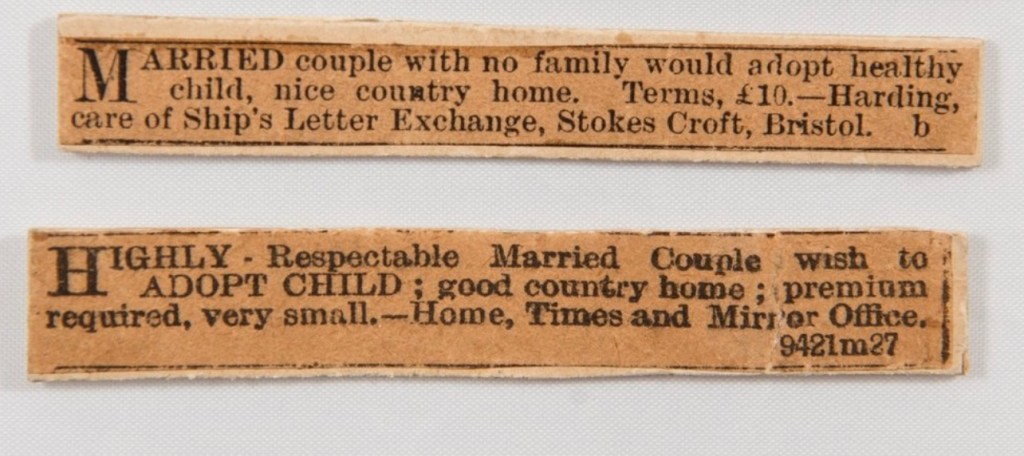
Sadly, Mrs Harding was yet another alias of Amelia and rather than returning to Reading, as she had told the young Mother, she actually headed to her daughter Mary Ann’s lodgings where she immediately murdered little Doris. Taking some white edging tape, used in dressmaking, the baby farmer wound it twice around Doris’s neck and tied a tight knot. Once the baby girl was dead the two women (allegedly, Amelia denied her daughter knew any of her crimes at the trial) wrapped her body in a napkin and hid it away.
Shockingly Amelia’s next murder would happen the very next day, on April 1st 1896 when a thirteen month old boy named Harry Simmons was dropped off at Mary Ann’s home. Once she was alone with the child the baby farmer took the edging tape from Doris’s neck, as she had ‘no more spare’, and used it to strangle Harry in the same manner. The next morning, April 2nd, Amelia stacked the bodies of poor Doris and Harry in a carpet bag, along with some bricks, and dropped them into the River Thames near Caversham Lock.
Now, whilst Amelia was carrying out these awful crimes, unknown to her she was already being investigated by the Reading Borough Police for the murder of another baby girl, who would later be identified as Helena Fry. On March 30th, the very same day that Doris Marmon was killed, a package was pulled from the Thames by a bargeman. Upon opening it he was met by the awful sight of a baby with white edging tape wrapped tightly around it’s neck. He handed it over to the Reading Police and Police Chief Constable George Tewsley immediately set his detectives to work. As the River Thames was dragged for more bodies, Detective Constable Anderson made a breakthrough back at the station. On the paper that Helena had been wrapped in there was a faintly written name and address which led straight to the home of Amelia Dyer, however this wasn’t enough evidence to make an arrest.
After reaching out to Bristol Police for more information and talking to potential witnesses the investigators became increasingly concerned and decided to put the Dyer (or Thomas, as was her current alias) household under surveillance. However, they were soon warned that the notorious baby farmer was well practiced at disappearing when there was the slightest whiff of suspicion. Deciding to use a different tactic they instead enlisted a young woman to use as a decoy, hoping she would be able to meet and discuss services with Amelia.
So it was, that on April 3rd 1896, when Amelia opened her front door to whom she thought would be her latest victim it was actually the police, who then proceeded to raid her home. Although no victims were found in the house detectives reported a foul smell of decomposition, they also gathered much more compelling evidence such as white edging tape, records of adoption arrangements, pawn tickets for children’s clothes, letters from Mothers asking after their children and receipts for newspaper adverts.
Amelia Dyer was officially arrested on April 4th 1896 and charged with murder, along with her daughter Mary Ann, and her son-in-law, Arthur Palmer, was charged as an accessory. He would be released soon afterwards, following a written confession by Amelia in which she stated that her daughter, Mary Ann, and Arthur had no knowledge of her crimes. As the police sorted through all of the documents found in Amelia’s home they calculated that at least twenty children had been placed in her care over the course of just a few months, the household should have been full of babies and yet there were none to be found. If this baby farmer had been operating at that rate for her entire career she could have been responsible for the deaths of over 400 babies and children.
During the search of the Thames six more bodies were found, including those of Doris Marmon and Harry Simmons, who were tragically the last of Amelia’s victims and died just a couple of days before her arrest. It was only eleven days after handing over her daughter to ‘Mrs Harding’ that Evelina Marmon was forced to identify her body.
On May 22nd 1896 Amelia Dyer was transported from Reading Gaol to stand trial at the Old Bailey, now one of the most infamous Criminal Courts in the UK which at this time was adjoined to Newgate Prison. She was charged with just one murder, that of Doris Marmon, as police believed this was the easiest to prove. However, they needn’t have worried as Amelia pleaded guilty, with her only defence being that of insanity. With the prosecution successfully arguing that this child killer had played the ‘mental instability card’ (their words, not mine) all too often to be believed, it took the jury only four and a half minutes to condemn her to death.
In a strange twist, or more likely an administrative mess up, Amelia was subpoenaed to appear as a witness at her daughter’s trial which was scheduled a week after her own execution date. When this quandary was brought before a judge it was ruled that Amelia was ‘legally dead’ once sentenced and therefore her evidence would be inadmissible. This may actually have helped Mary Ann’s case as, the day before her Mother’s execution, the charges were dropped against her.
At 9am on June 10th 1896, Amelia Dyer, notorious baby farmer and serial child killer, was hanged at Newgate Prison. On the scaffold, when asked for her last words, she replied ‘I have nothing to say’.
With regards to her legacy, not only did Amelia inspire the ballad at the top of this page, sung by children and adults alike all across the streets of Victorian London, but her case also drew attention to the dangers faced by children born out of wedlock or into poverty. Her case became a media sensation, prompting public outcry and forcing the government into action. In 1897 the Infant Life Protection Act was passed which sought to safeguard children by imposing stricter controls on baby farming and adoption. Of course, there was still a lot of progress to be made and it would take years before fostering and adoption was properly monitored and regulated. Even to this day there are sadly still children who ‘slip through the cracks’.
Amelia was certainly not the only baby farmer guilty of the mistreatment and subsequent deaths of thousands of children, and it wasn’t just happening in England. Records can be found in both America and Australia of baby farmers being hanged for the murders of their charges. Some even argue that she was also not the worst, that the horrors of Victorian baby farming ran far deeper. That being said her crimes were appalling and earned her a rightful place in England’s darkest criminal history, the photograph taken of her on the day of her arrest is now the face that we picture in our minds when talking of an industry that was not only born, but also allowed to flourish, out of extreme prejudice.

Mystery of the Mary Celeste
In October 1872, Captain Benjamin Briggs was busy preparing for his maiden voyage on board the newly refitted…
Keep reading
Christine Ida Collins
When her son, Walter, failed to return home on March 10th, 1928, after taking a trip to the…
Keep reading
The Curse of King Tut’s Tomb
Ta-sekhet-ma’at, translating to ‘The Great Field’, is known to us today as the Valley of the Kings. Here,…
Keep readingSomething went wrong. Please refresh the page and/or try again.
 Law & Lore Archives
Leave a comment