


Mystery of the Mary Celeste
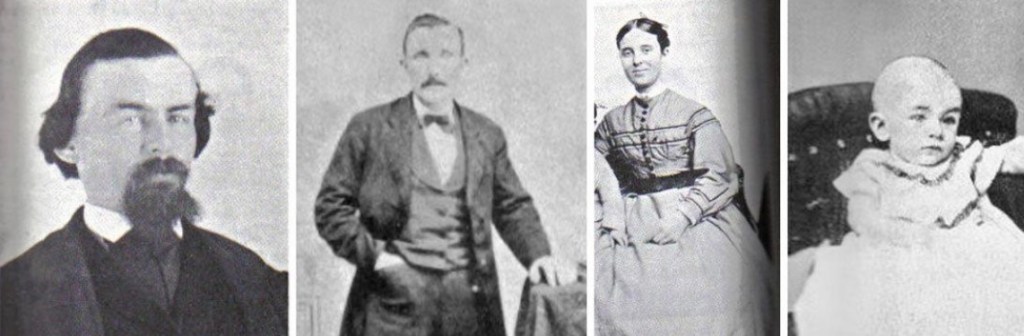
In October 1872, Captain Benjamin Briggs was busy preparing for his maiden voyage on board the newly refitted Mary Celeste. He and his fellow members of the owners consortium, including James H. Winchester who was the main shareholder, had paid out $10,000 (approx. $265,000 today) to drastically increase her size and add a new deck. His journey would take him to Genoa, Italy, where he and his carefully selected crew would deliver a large cargo of denatured alcohol.
Side note; denatured alcohol is poisonous and unfit for drinking, it is primarily used for industrial purposes such as paint removal, adhesives, antifreeze and preservation. It is also highly flammable.
So confident was he in his ship, crew and voyage, Captain Briggs decided to take his wife, Sarah, and 2-year-old daughter, Sophia, with him. Looking back, we must presume that this confidence was not foolish or misplaced, born to sea captain Nathan Briggs in 1835, Benjamin was now highly respected within the maritime industry and had over forty years of experience and successful voyages behind him. Both he and Sarah wrote to their respective mother’s shortly before the voyage, he stating that he was ‘eminently satisfied with his crew’ and she writing that the crew appeared to be quietly capable ‘if they continue as they have begun’.
Early on Tuesday, November 5th, 1872 the Mary Celeste moved from its mooring and entered New York Harbour in preparation to head out to sea. However, in an example of his experience and caution, Captain Briggs decided instead to drop anchor at Staten Island, unhappy with the weather conditions. Two days later, on Thursday, November 7th, 1872, the weather cleared to his satisfaction and the ship left the harbour, heading out across the Atlantic Ocean.
It would be almost a month later when, at roughly 1pm on December 4th 1872, Captain David Morehouse of the Canadian brigantine Dei Gratia was informed by one of his helmsman that a ship had come into view which appeared to be moving erratically towards their own vessel. The sailor also reported that not only did the other ships course seem unplanned but its sails were not in the expected position for the current conditions. Joining his men on deck, Morehouse watched as the other ship grew closer and, once it was within a good distance to do so, he sent a signal. Then he sent another and another, but there was no reply and as it drew even nearer, he could see that there was nobody on its deck. The presence of the other vessel was deeply unsettling to the captain and to his crew, but as perturbed as they were Morehouse knew that the mysterious ship must be investigated.
It was decided that first mate Oliver Deveau and second mate John Wright would head out in one of Dei Gratia’s smaller boats under the watchful eyes of their captain and fellow crewmen. The two men expertly manoeuvred their boat to the side of the larger ship, taking note of the name displayed upon the stern before climbing aboard the Mary Celeste. Once on deck, the two men noted that the ships sails were partly set and in poor condition, with their ropes hanging uselessly over the sides and, whilst the main hatch was closed, those at the fore and lazarette were open.
Side note; the lazarette hatch is commonly used as a storage locker for spare lines, sails, repair equipment and tools.
Before moving to explore below deck they also discovered that the small lifeboat that had sat over the top of the main hatch was gone and the binnacle that housed the ship’s compass was out of position and its glass cover damaged. They also came across a dismantled bilge pump and an abandoned sounding rod, a device used to measure the amount of water in a ships hold.
Side note; A binnacle is a waist-high case that stands on the deck of a ship which houses navigational instruments, most crucially a magnetic compass.
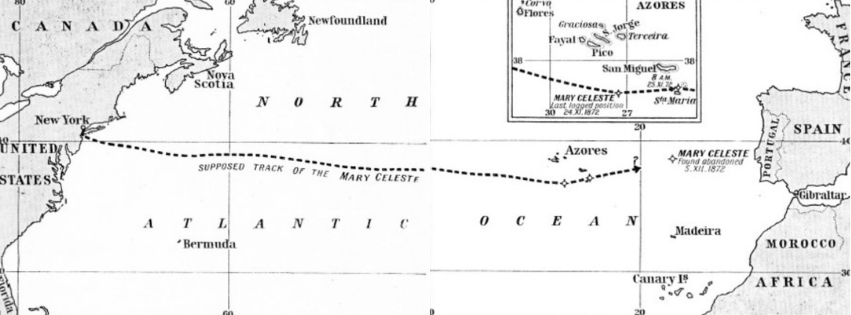
Due to the discovery of the pump and sounding rod they headed to the hold next, where they found its floor submerged in around 3.5 feet of water. Whilst this level of water would be treated as significant by a Captain and his crew, it would certainly not be enough to cause alarm or panic for a ship the size of the Mary Celeste. Very aware that that they had not yet encountered any crew, dead or alive, the two men then made their way to the mate’s cabin. Here they found the ship’s log, which had been diligently filled in daily until November 26th 1872. The final entry, dated 8am on November 25th, recorded the Mary Celeste’s position as being in the Azores, almost 400 nautical miles (460 miles or 740 km) from where the Dei Gratia had spotted it and 1700 nautical miles (1957 miles or 3100 km) from its final destination.
Upon their return to the Dei Gratia, Deveau relayed his and Wright’s findings to Morehouse, stating that although the interior quarters were wet and disarrayed from water entering through the open hatches and doors, they seemed to be in reasonable order and showed no signs of fire or violence. The captain’s cabin still held personal items, including a sheathed sword under the bed, but many papers expected to be found were missing, as were the navigational instruments. In the galley, equipment was neatly stowed away and there was no evidence of prepared food having been left abandoned. The Mary Celeste’s cargo, a large amount of denatured alcohol, also appeared untouched.
Following his first mate’s report, Captain Morehouse decided to undergo the difficult journey of sailing both ships to Gibraltar, 600 nautical miles away (690 miles or 1100 km). Under maritime law, the abandoned Mary Celeste would be recognised as salvage and Morehouse believed that he and his crew would receive a healthy payout for its return, especially in its condition with an untouched cargo. There was, of course, also the mystery of just what had happened to the crew of the ghost ship. Despite the weather remaining calm and there being no difficult encounters with other vessels, progress was slow due to Morehouse having to split his crew between the two ships. But finally, on December 12th, the Dei Gratia reached Gibraltar, with the Mary Celeste arriving the following morning after running into some fog.
On December 17th 1872, the salvage court hearings regarding the Mary Celeste began, under the chief justice of Gibraltar, Sir James Cochrane, and conducted by Frederick Solly-Flood, Attorney General of Gibraltar. Flood, a man once described by a historian as someone ‘whose arrogance and pomposity were inversely proportional to his IQ’, seemingly begun the hearings with an already strong, and heavily biased, opinion on the case. In a rather outstanding display of his ignorance of maritime industry and prejudice against those employed by it, he latched onto the cargo of (undrinkable) alcohol as a reason for supposed foul play and took every avenue available to him to prove it.
The hearings would stretch on for over two months, with Flood desperately trying to prove his theory that the crew of the Mary Celeste had gotten drunk on the ship’s cargo, murdered the Briggs family and officers, then fled in the lifeboat (or yawl), probably to meet their fate somewhere on the vast ocean. At first the physical examinations of the ship seemed to support his theory, with cuts noted on each side of the bow, possible blood traces on both the captain’s sword and a handrail, which also showed a deep cut that could have been caused by an axe. He also suspected that Morehouse and his crew were hiding something, believing that the ship could not have drifted so far whilst unmanned and that they had doctored the log.
James Winchester, the main shareholder of the Mary Celeste, arrived in Gibraltar on January 15th, 1873, to enquire as to when the ship would be released so she could finish her journey and deliver her cargo. He was most displeased when, firstly, he was informed that he would need to hand over $15,000 (approx. $334,000 today) for this to happen (he didn’t have it) and, secondly, when he realised that Flood was suggesting he was somehow involved in the crew’s disappearance.
Things came to a head between the two men when, on January 29th, Flood pushed Winchester to admit that he had an arrangement with Briggs to deliberately abandon the ship in an insurance scam. There were several heated exchanges in which the consortium head disputed these claims, stating that Briggs had impeccable character and would have only abandoned ship if there was no other choice. The Attorney General’s dramatic theories of mutiny and murder were shaken once more when results came back stating that the ‘blood stains’ were in fact not, and a US Navy Captain, commissioned to carry out his own examination, stated that he believed the cuts to the bow were caused by the actions of the sea.
Finally, on February 25th, 1873, Flood had no choice but to release the Mary Celeste to James Winchester, and two weeks later she set sail once more, this time with a locally raised crew headed by Captain George Blatchford. Despite successfully completing her voyage and returning to New York in September 1873, the Mary Celeste would forever be seen as a ‘cursed ship’. Although Flood had not gotten his way when it came to the hearings, he had done a very effective job of inciting newspaper stories and whispered rumours of blood and death onboard the Mary Celeste. She would change hands several times, never quite undertaking the impressive voyages of past years, and in 1885 would, ironically, be deliberately run aground in Haiti as part of an insurance scam.
Side note; In August 2001 marine archaeologist Clive Cussler claimed that he had uncovered the remains of the Mary Celeste embedded in the Rochelois Reef. However, later tests on the wood prompted strong refutes to his claims, showing it came from trees in the US State of Georgia, that would still have been growing in 1894.
And what became of Captain Morehouse and the Dei Gratia crew? They would indeed receive a salvage payout, on April 8th 1873, four months after they brought the abandoned Mary Celeste into Gibraltar. However, they would only receive $1700 (approx. $46,000 today) which was a fifth of the rescued ship and its cargo’s worth. This amount was decided upon by Sir James Cochrane, the Chief Justice of Gibraltar, and the infamous Flood’s boss. When his decision was questioned, not just by Morehouse but also by another authority, Cochrane voiced his displeasure over the decision to send the Dei Gratia to deliver her cargo halfway through the hearings. Despite the fact that her Captain had remained on the island at the disposal of the court, Cochrane believed that the ship and crew should have also remained available to them. This publicly harsh criticism meant that Morehouse and his crew would forever have a veil of suspicion over them.
Captain Benjamin Briggs, his wife and daughter, and his crew were never found. His son, Arthur, who had been left with his Grandmother so as not to interrupt his education, grew up being taken care of by close family members. Understandably refusing to follow the family tradition of seafaring, he became a book-keeper, got married and would be a father himself. He passed away in Massachusetts on October 31st, 1931, having never found out what had happened to the rest of his family.
From the time of the empty ship’s discovery right through to modern day, there has been many a theory when it comes to the mysterious Mary Celeste and her missing crew. Over the years we have been brought many books, plays, TV shows and films that, in some way or another, touch on the story of the infamous ghost ship. In some cases, along with rather embellished newspaper articles from the time, the original tragic tale has been twisted so much, that modern day audiences are left with a rather differing view of the truth. We have only to look at the dramatic retellings on social media, the desperate need to attention grab in a saturated market, the three minute videos because any longer and audiences scroll away, plus the lack of research, all contribute to the continuation of misinformation.
Despite being one of the older sources of ‘information’ regarding the Mary Celeste, Conan Doyle’s story ‘J. Habakuk Jephson’s Statement’, written when the author was a 25-year-old ships surgeon, continues to be perhaps the most influential. He renamed the ship ‘Marie Celeste’, a key fact that still gets muddled to this day, so even with the names of those on board changed, his fictional tale of a fanatic who murders all but one, continues to be referenced in ‘factual’ accounts of the Mary Celeste.
A Selection of Theories.
- The Quarterly Review published an article in 1931 accusing Captain Morehouse and his crew of lying in wait for the Mary Celeste before luring them aboard the Dei Gratia and subsequently murdering them. This theory falls rather flat however, when you take into consideration that the Dei Gratia was a slower vessel and left New York seven days after the Mary Celeste.
- Briggs and Morehouse were acquainted with one another and conspired to share any salvage proceeds. This theory could be in the realms of possibility as they were both well known in the maritime industry and were also in New York at the same time. However, there is no evidence of a friendship between the two men, and people question as to why Briggs left his son Arthur behind if he had known he would be disappearing permanently.
- Pirates – It was suggested that the Mary Celeste was attacked by Riffian pirates, who were active off the coast of Morocco in the 1870’s. But with the cargo and personal possessions of the crew, some being quite valuable, being left untouched this theory seems unlikely. (Riffians are originally from the Rif region of Morocco).
- Historian, John Lockhart published a piece in 1925, speculating that Briggs, a religious man, had killed all on board and then himself in a fit of mania. This theory may well have been influenced by Conan Doyle’s earlier work of fiction, and he later went on to issue an apology to Briggses descendants and publicly withdrew his theory.
- Oliver Cobb, Captain Briggs’s cousin, speculated that the life boat had been launched as a safety measure against possible explosion from the alcohol or flooding in the hull, and had originally been tethered to the main ship, which would have allowed the crew to pull them back to the Mary Celeste when the danger had passed. There are arguments that the experienced captain would not have risked staying tied to a ship that was about to explode or sink but also counterarguments that he also would not have relied on a small yawl for survival over that of a possibly still seaworthy ship.
- A New York insurance appraiser named Arthur Putman also focused on the missing lifeboat. He discovered evidence of the rope being cut rather than untied, which pointed to a swift abandonment of the Mary Celeste. He also referred to the ships log, in which were documented several accounts of the sound of rumbling and small explosions coming from the hold. Whilst this would not be enough to panic such an experienced captain and crew, he theorised that a larger explosion occurred which displaced the hatch and caused them to evacuate quickly.
- First mate of the Dei Gratia, Oliver Deveau, pointed out the discarded sounding rod found on deck and suggested that perhaps Briggs had abandoned ship after a false reading. In line with this theory others have surmised that a severe waterspout strike could explain the state of the rigging and sails, and flooded the pumps causing this false reading. (A waterspout is a rotating column of air that occurs over water. The spray vortex can create a huge wake and when dissipating will drop its huge volume of water).
- An earthquake on the seabed could have affected the cargo enough to have resulted in the release of noxious fumes, the loosened hatches possibly point to evidence of an inspection and attempted airing of the hold. With the very real threat of an imminent explosion, Captain Briggs could have made the decision to abandon ship. This theory is heavily debated as at the time the cargo and hold showed no signs of an explosion or even disruption. However, in 2006 chemist Andrea Sella conducted an experiment to try to prove it was possible. Using paper cartons and butane gas he created an explosion strong enough to produce a fireball, but when the flames had dissipated there was no fire damage to the replica hold. This is called a pressure-wave explosion, which produces quite a show fire-wise but behind it is cool air, it leaves no soot, scorching or burning.
- The Mary Celeste had often transported coal and it was theorised in the documentary ‘The True Story of the Mary Celeste’ (Smithsonian Channel) that dust build up could have caused pump congestion and instrument malfunction. Perhaps experiencing rough seas, Briggs would have had no accurate way to tell how much water had been taken on, and, with a possibly faulty chronometer, believed them to be closer to land than they actually were. The main evidence for this scenario was the dismantled pump found on deck and the discarded sounding rod.
The Mary Celeste is certainly not the only ghost ship to have been found on the vast oceans of our Earth but it is perhaps now the most infamous. It is widely believed by experts that her remains, once somewhere in Haiti, will have long been rotted away, taking with them any remaining insights into what happened to Captain Briggs, his family, and his crew.
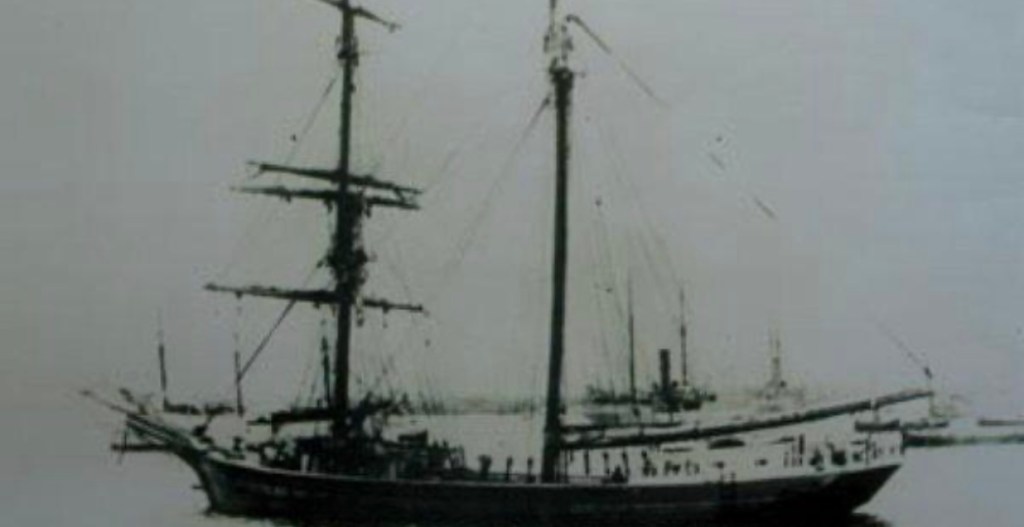
On August 7th 1963, a plaque and Cairn were unveiled on Spencer’s Island, Nova Scotia, commemorating them. It was here in 1861 that the Amazon, later to become the Mary Celeste, was built.
In memoriam –
Captain Benjamin Briggs
Sarah Elizabeth Briggs
Sophia Matilda Briggs
Albert G. Richardson, First Mate
Andrew Gilling, Second Mate
Edward William Head, Steward
Volkert Lorenzen, Crew
Boz Lorenzen, Crew
Arian Martens, Crew
Gottlieb Goudschaal, Crew

Part One; Josslyn Hay, 22nd Earl of Erroll
Early in the hours of January 24th, 1941, Josslyn Victor Hay, 22nd Earl of Erroll was found shot…
Keep reading
Christine Ida Collins
When her son, Walter, failed to return home on March 10th, 1928, after taking a trip to the…
Keep reading
The Curse of King Tut’s Tomb
Ta-sekhet-ma’at, translating to ‘The Great Field’, is known to us today as the Valley of the Kings. Here,…
Keep readingSomething went wrong. Please refresh the page and/or try again.


Leave a Reply