

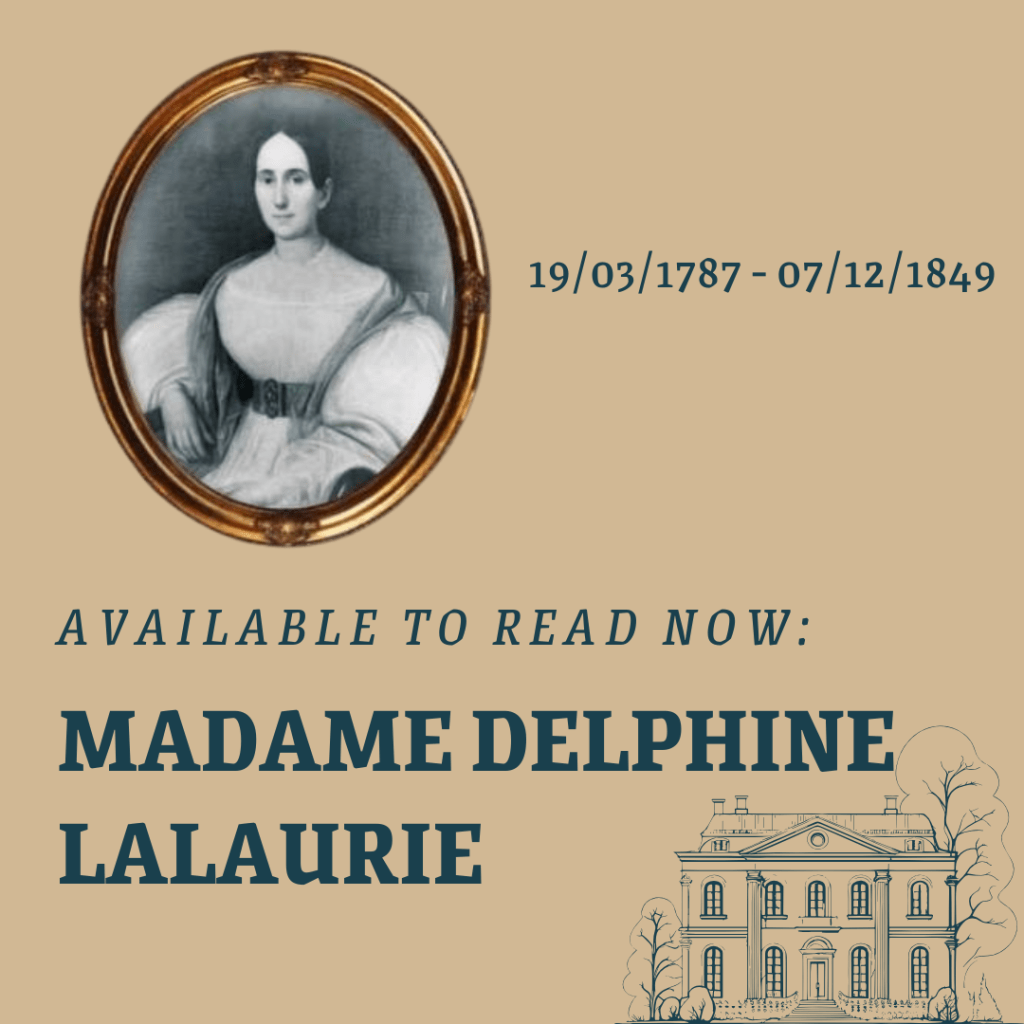
The story of Delphine LaLaurie has permeated popular culture, cementing her place as a figure of enduring, yet horrified, fascination. Her life and crimes have been the subject of numerous books, films, and television series, each adding layers to the mythos surrounding her. One of the most notable modern portrayals was by Kathy Bates in the television series “American Horror Story: Coven,” which blended historical facts with fictional, supernatural elements. This portrayal, while obviously dramatized, reignited the public’s interest in LaLaurie’s story and the depiction of her as a monstrous figure who engaged in grotesque experiments and tortures both appalled and captivated audiences.
But just who was Delphine LaLaurie, and how did she become one of history’s most reviled public figures during a time when slavery and its brutalities were a societal norm?
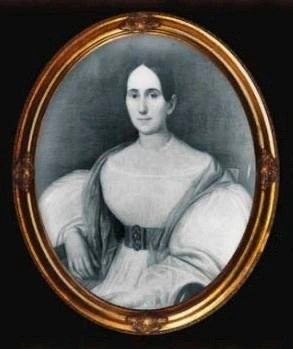
She was born Marie Delphine MacCarthy on March 19th 1787, to Louis Barthelemy de MacCarthy and Marie Jeanne nee L’Érable. The family were very prominent in the New Orleans European Creole community and the young Delphine would have been raised in an affluent and privileged environment. She would also have grown up surrounded by enslaved people and learnt from watching her peers just how these people should be viewed and treated. There are records that suggest that in the years following her eventual flee from New Orleans Delphine often voiced her confusion as to why she could not return home, and a complete lack of understanding of what she had done wrong. This apparent blind spot when it came to her actions could well be traced back to her childhood; what she had been doing, in her eyes, was simply just how things were done.
The young Delphine would also have witnessed the direct consequences of several uprisings amongst enslaved people against their owners. In 1771 her uncle had been killed by his slaves and over the next twenty years several more rebellions took place. When she was four the infamous Haitian Revolution erupted, and this caused slaveholders in the Southern United States to become very nervous, which led to even more extreme abuses of the people forced to serve them. These atrocities would too become normalised to the young girl.
Sidenote; The word ‘Creole’ has a complex, often problematic, history. You can find more information about the evolution of its meanings here – https://www.datacenterresearch.org/pre-katrina/tertiary/creole.html
Just three months after her 14th birthday, Delphine would marry her first husband, Don Ramon de Lopez y Angulo, a prominent Spanish Royal Officer who was 21 years her senior. Ramon was recently widowed; his wife having lost her life during a particularly treacherous voyage from Spain to Louisiana. It is said that he had wanted to delay the voyage for one month, citing the dangers that could befall them but had been ordered by the Spanish Crown to leave immediately. It seems that the Officer, despite marrying Delphine, still felt some bitterness towards Spain and he began to disobey direct orders. Eventually he was removed from his prominent position of 2nd to the Louisiana Governor and forced to travel wherever the Crown told him to. Through many efforts Ramon eventually managed to receive a pardon from the Queen and was appointed Spanish Consul to New Orleans under what was now the American Administration. Victorious, he set off for Havana, where Delphine, who was now pregnant, was waiting for him. Sadly, he would never make it, his ship ran aground just off the coast of Havana on January 11th 1805 and he was killed, his actual cause of death is unknown. Shortly after, Delphine gave birth to their daughter, Marie Delphine Francisca Borja Lopez y Angulo de la Candelaria and she returned to New Orleans following the burial of her late husband.
Upon the young widow’s return to New Orleans, she discovered that her home town was now under American ownership, following the infamous Louisiana Purchase. Despite the political upheaval that came with the Purchase, including the laws surrounding slavery, Delphine’s family name and wealth saw her less impacted than many other residents. Two years later, in March of 1807, she would marry her second husband, Jean Paul Blanque. Delphine’s mother had recently passed away, dividing her estate between her three children, she also left her daughter a plantation, inclusive of its slaves, livestock and equipment. Her father also gifted the new couple another plantation and an additional twenty-six slaves. From the outside Delphine and Jean seemed to live a gilded and privileged life, they spent much of their time travelling between their properties along with their eventual five children. Then, in 1815, Jean Paul passed away and the truth of his ‘business acumen’ was revealed, with Delphine having to find a way to pay off over $2.5 million in debt. At this time she was twenty-eight years old.
Over the next ten years Delphine worked her way out of her late husband’s crippling debt, separating her finances from his and auctioning off his property. During this time her father would pass away, which brought Delphine a great deal of sadness but also a healthy inheritance. This would mean that by 1825, Delphine had accumulated considerable wealth and was an experienced businesswoman.
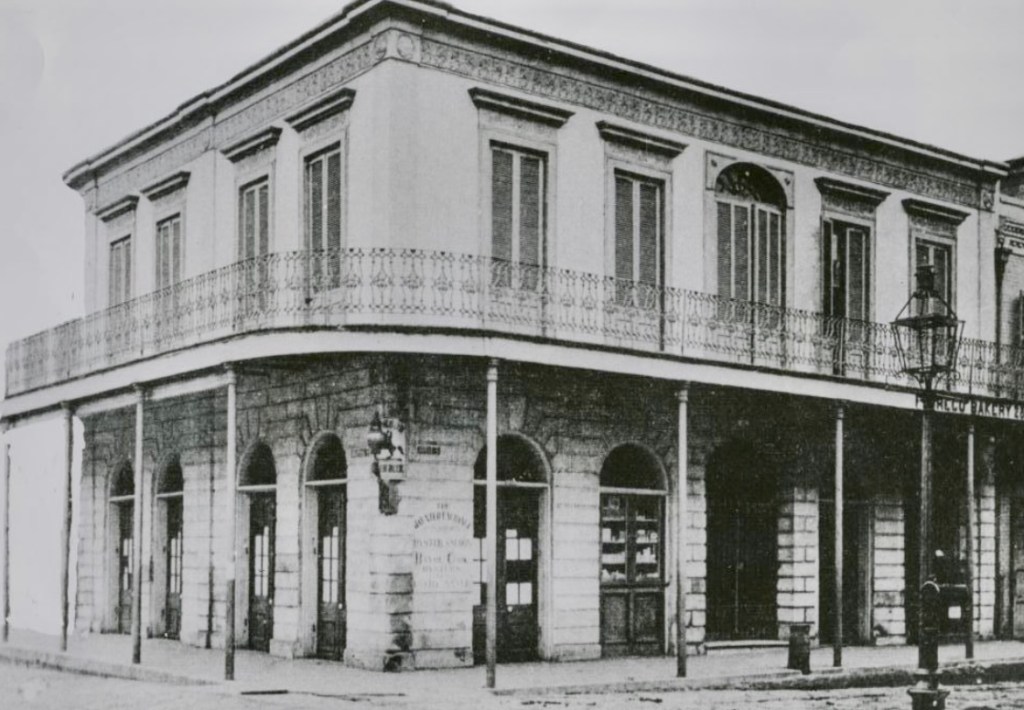
This would also be the year that Dr Leonard Louis LaLaurie would arrive in New Orleans. The doctor was young and driven, a chiropractor who had big plans to set up a practice where he could ‘destroy hunches’. Luck would see him arrive at Delphine’s door in 1826 to treat one of her children and so a romance blossomed. After being married to men far older than her, this time the tables were turned, Delphine was now thirty-eight, a rich widow two times over and with five children. They married on June 25th 1825 and, in 1831, Delphine purchased a property at 1140 Royal Street. Over the next year she had a two storey mansion built, complete with attached slave quarters, where the family would spend most of their time, the position of the property allowing the socialite to maintain a central role in New Orleans society.
Sadly, however, all was not well inside the LaLaurie household. It is rumoured that the couple often argued, loudly and violently, with many separations and reconciliations happening over the years. And it seems that by the end of 1832 Delphine had had enough, she petitioned the court for a separation, citing her mistreatment by Dr LaLaurie which included a witnessed beating, the court found in her favour and Leonard moved out.
Rumours of the LaLaurie’s mistreatment of the people they had enslaved had begun a year previous to the couple’s separation and continued right up until the infamous fire at Royal Street, in 1834, by which time Leonard had returned to the family home. According to Harriet Martineau, an author and abolitionist, the accounts varied during these years but most agreed that Delphine’s enslaved appeared ‘haggard and wretched’ when compared to their counterparts. It was also noted by many that Delphine was very good at ‘keeping up appearances’ in public, showing politeness to Black people and seemingly being mindful of her enslaved people’s health. Despite this veneer of respectability, a local lawyer was dispatched to the Royal Street mansion, in order to remind the LaLauries of the law when it came to enslaved people and to see if he could find any evidence of their mistreatment. He sadly left empty handed.
Side note; the laws cited to the LaLauries would have come from Le Code Noir, originally a decree passed by King Louis XIV of France in 1685 which defined the conditions of slavery in the French Colonial Empire. It was originally created to help slave owners traverse the legalities and politics of transporting, buying and selling slaves. It also included detailed religious restrictions and punishments. By Delphine’s time it had been frequently altered and added to, mainly to incorporate new ‘rights’ for the enslaved. Rights, which of course, should never have been stripped away in the first place. Not only did millions suffer appalling physical atrocities during the time of slavery, but entire cultures and their histories, traditions and religions were completely erased, some of which are still lost to this day.
Not long after the lawyers visit, an incident would take place that would lead to a more official investigation. A neighbour would bear witness to the death of an enslaved girl, estimated to be between eight and twelve years old. She would later be given the name Lia (or Leah) in retellings but sadly nobody is sure of her real name. It is rumoured that ‘Lia’ was brushing Delphine’s hair when she caught a snag and sparked the socialite’s temper, who caught up a whip and chased the young girl through the house. The witness claims that she saw ‘Lia’ fall from the mansion roof as she tried to escape the whip of her mistress. The subsequent investigation found the LaLauries guilty of illegal cruelty and they were forced to forfeit nine of their enslaved (nope, no prison for the rich). Also, disgustingly, the nine enslaved were bought by a relative of the LaLauries and soon found themselves back at the Royal Street residence.
Thankfully, the LaLauries luck would eventually run out on April 10th 1834, when a fire broke out in the kitchen at 1140 Royal Street. The first person to be discovered by the fire marshals was an enslaved cook, a 70 year old Black woman, who was chained to the stove by her ankle. She would later admit that she had started the fire deliberately in a suicide attempt.
Meanwhile the bystanders outside noted that it was the LaLaurie’s themselves who were carrying out their belongings in case the fire should spread. An unusual sight for a household who purportedly had at least nine slaves at their disposal. Amongst the crowd was Judge Jean Francois Canonge, who approached Delphine’s husband and questioned him about the enslaved still in the property. After the Judge was essentially told to mind his own business it is rumoured that several people demanded the keys to the slave quarters/attic (?), in order to ensure the escape of those inside, but all were refused.
This is where many accounts detail the charging of the doors of the residence and the shocking discovery in the attic/slave quarters (?) of at least seven enslaved people all displaying signs of abuse, sickness and starvation. It is said that they all wore varying forms of heavy iron chains and some the, now outlawed, iron spiked collars which were designed to keep the head in one position. Although some sources tell of far worse; mutilation, missing limbs and horrific experiments performed by Leonard, it seems that many of these accounts have been exaggerated. An exaggeration unnecessary as even the most realistic of witness statements tell a tale of terrible abuse. As word of the slaves’ condition travelled outside of the mansion and into the remaining crowd, a mob mentality began to grow. It seemed that these terrible acts were a step too far, even for the old school Louisiana set. The LaLaurie Mansion was rushed upon and it is said those present that night destroyed everything that they could lay their hands on.
So, just where was Delphine LaLaurie whilst all of this was happening? Some say that in the chaos she slipped into her carriage unheeded to make her escape but others report that it was actually brought around to the front of the residence and she stepped into it with her head held high in the face of the angry mob. Whichever is true, she most certainly did successfully leave New Orleans that night after boarding a schooner on Lake Pontchartrain. The journal of an American poet, William Cullen Bryant, documents him setting sail for France from New York and mentions ‘a pretty looking French woman… a Madam LaLaurie’. He goes on to talk of her crimes against the slaves, revealing that her reputation was now well-known at least across the America’s. Also, thanks to William’s journal, we know that she set sail along with her husband, Leonard.
Once in France Delphine made her way to Paris, living in exile along with two of her daughters, Pauline and Laure, and her son Paulin. It seems that at some point Leonard left his wife and it is rumoured he ended his days in Havana. In the summer of 1842 Paulin would write to his brother-in-law, Auguste DeLassus, revealing that Delphine was determined to return to New Orleans and, in fact, seemed quite confused as to why she had to leave in the first place. Thankfully, he writes, the disapproval of her children was enough to discourage her from this plan.
According to the French archives, Delphine died in Paris on December 7th 1849, at the age of 62, however in the late 1930’s an old, cracked memorial copper plate bearing her name and the date December 7th 1842 was discovered in the St Louis [No.1] Cemetery, situated only a block away from the French Quarter in New Orleans. The inscription claims that she did indeed die in Paris but puts the date 7 years prior to France’s records.
The LaLaurie Mansion sat abandoned for four years, the once grand home of Delphine now a ruined shell with missing windows and walls, and displaying signs of the fires set by the raging crowd. In 1838 it was rebuilt by Pierre Trastour [spelling?] and took on a much altered appearance from it’s original. Over the years it was used as a music conservatory, school, luxury apartments, a refuge, bar and even a furniture store; additions were also made, including a third floor and a rear building. The residence changed hands a number of times through the decades, even being purchased in 2007 by actor Nicholas Cage, and now belongs to Michael Whalen after he paid $2.1 million for it in 2010. Despite the LaLauries’s home changing so much to the point where now there is hardly, if any, of the original building intact it is still a huge tourist attraction in New Orleans, and never fails to be mentioned on the infamous Ghost Tours of the city.
And the enslaved people that were released that night? Sadly, of course, they didn’t really find freedom. Disgustingly, they were taken to a local jail where they were available for public viewing. It was reported by The New Orleans Bee, in their April 12th 1834 edition, that up to 4000 people had attended to view the slaves in order ‘to convince themselves of their sufferings’. Then on May 8th 1834, The Pittsfield Sun reported that two of the slaves had died since their emancipation from the LaLaurie’s. The newspaper also mentioned the discoveries made in the grounds of the mansion;
‘We understand … that in digging the yard, bodies have been disinterred, and the condemned well [in the grounds of the mansion] having been uncovered, others, particularly that of a child, were found’. It is believed that the remains discovered in the well were that of ‘Lia’, the young girl who fell to her death whilst running from Delphine.
The story of Madame Delphine LaLaurie gives the most minuscule glimpse into the history of slavery in the US and, indeed, the rest of the world. It is widely believed that she had no concept of her wrongdoings because to her it was normal, her family were wealthy slave owners, her childhood years bearing witness to the mistreatment and dehumanisation of Black people. And there were many more like Delphine and her family, all over the world. Acts that shock and disgust us now were normalised within just one generation. A sombre warning, and reminder, for those of us today.
Linked here is the Wikipedia page ‘Slavery in the United States’, and there you will find many more sources, including Slavery in Europe; https://en.wikipedia.org/wiki/Slavery_in_the_United_States
Details of Delphine’s early life can be found here; https://en.wikipedia.org/wiki/Delphine_LaLaurie#cite_note-Pittsfield_Sun_8_May_1834-24

Mystery of the Mary Celeste
In October 1872, Captain Benjamin Briggs was busy preparing for his maiden voyage on board the newly refitted…
Keep reading
Christine Ida Collins
When her son, Walter, failed to return home on March 10th, 1928, after taking a trip to the…
Keep reading
The Curse of King Tut’s Tomb
Ta-sekhet-ma’at, translating to ‘The Great Field’, is known to us today as the Valley of the Kings. Here,…
Keep readingSomething went wrong. Please refresh the page and/or try again.
 Law & Lore Archives
Leave a comment